 Nederlands
 Français
 Deutsch
Why does Robinia grow crooked?
Robinia is a true sun-seeker. The tree grows quickly and constantly reaches toward the light. If a neighboring tree gets in the way, the trunk simply bends along with it toward where the sun does shine. Wind, a slope, or a side branch that takes over also leave their mark on the shape of the trunk.
In addition, unlike, say, a Norway spruce, Robinia has not been bred for straight, uniform trunks. It is a wild, headstrong tree. Every post we supply is therefore a section of a trunk that has sought its own path toward the light. No two are alike.
Crooked, but rock-solid
A crooked pole is not a weak pole. On the contrary, there are three good reasons why you don’t need to worry about it.
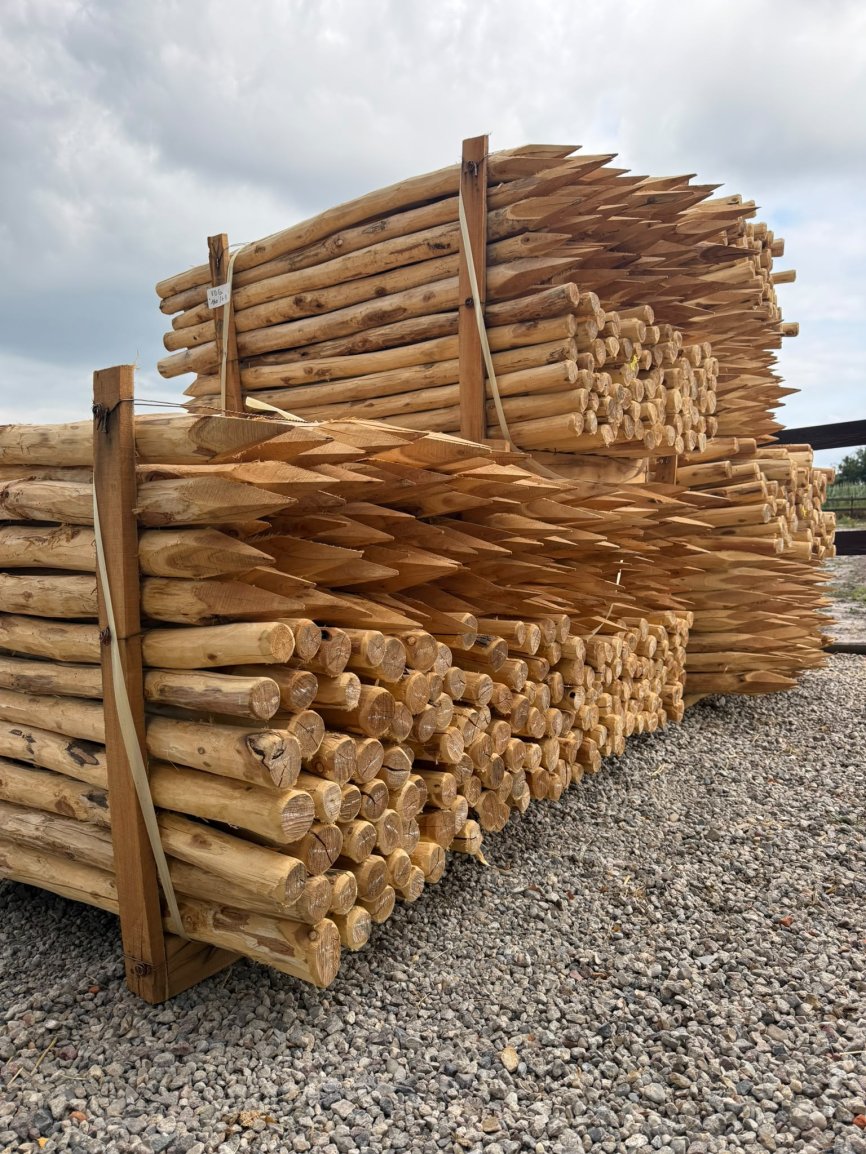
1. The wood fibers remain intact. Our round posts are debarked and tapered, but not cut straight. The fibers therefore still follow the natural shape of the trunk, from bottom to top. Cutting a crooked trunk straight severs those fibers and actually weakens the wood. A debarked post with a bend is therefore often stronger than a straight-cut post of the same thickness.
2. Durability lies in the wood itself, not in its shape. Robinia is one of the most durable European wood species and will last for years in the ground without chemical treatment. Whether the post is straight or curved makes no difference in this regard. You can read more about this in our blog post on wood durability classes.
3. We measure accurately. We measure the diameter of our posts at the center, not at the thickest point. This ensures that the post is sturdy enough along its entire length, even if it curves. You can read about why this makes a difference in “Robinia Posts: Why Diameter Measurement Makes a Difference.”
Character in Your Fence
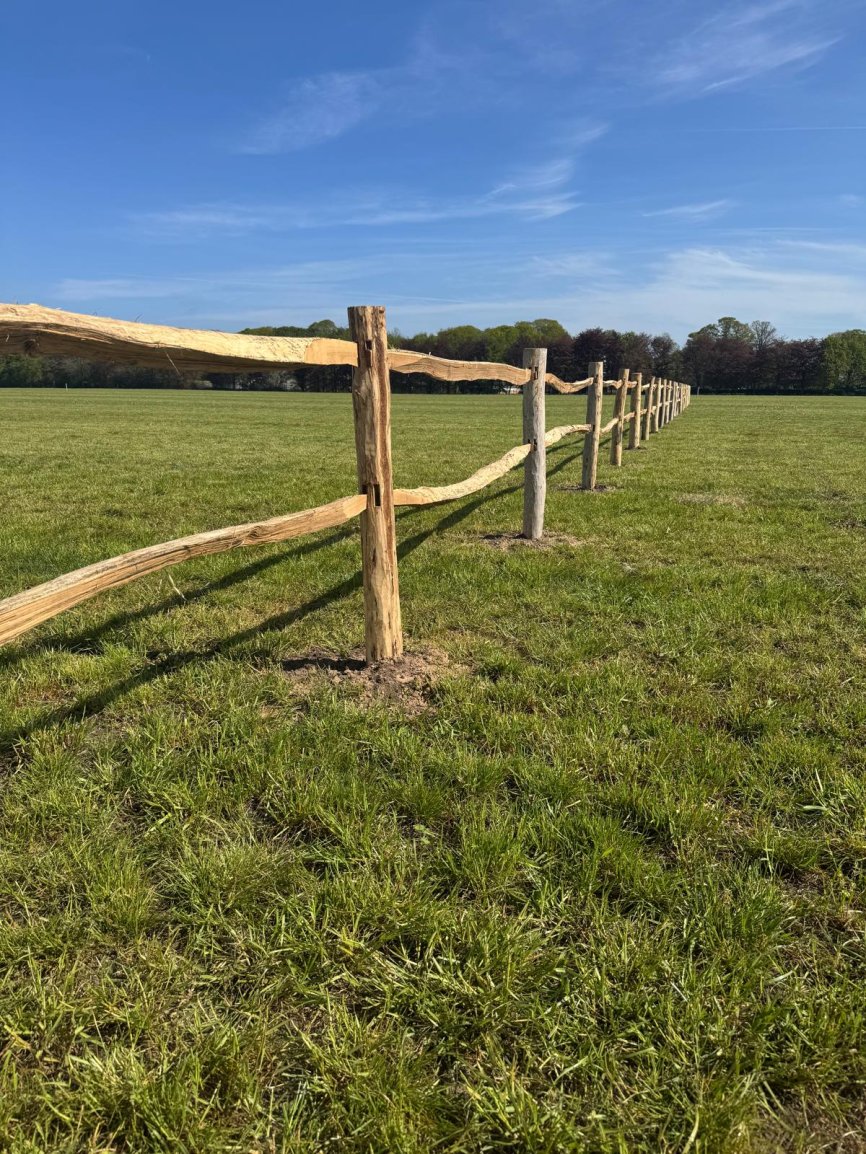
When you choose robinia, you’re choosing a natural look. A row of posts, each with its own unique shape, fits perfectly in a meadow, a rural garden, or a play area. It’s precisely that irregularity that makes a fence lively and authentic.
With a few simple tips, you can still achieve a nice, clean look:
Rotate the post before securing it. Align the curve with the line of your fence, not toward or away from it. This way, the row will appear much straighter when viewed from the front.
Place the straightest posts in the most prominent spots. Use them at the gate, on the corners, or along the driveway.
Use a string. Stretch a string between the starting, corner, and ending posts, and align each post with it. You can find more tips in our blog post “How to Best Install Your Robinia Posts.”
Let the wire mesh or sheep fence do the work. Once the fencing is taut, a slight curve is barely noticeable.
In short
A curved Robinia post isn’t a manufacturing defect, but proof that you’re working with genuine, untreated natural wood. The fibers are intact, the durability remains the same, and your fence gains character.
Looking for Robinia posts for your pasture or garden? We’d be happy to help you choose the right length and diameter.